
London Business School
History
The London Business School, as it is now known, was founded in 1964 as the London Graduate School of Business Studies by the British National Economic Development Council in response to the success and popularity of business schools in the U.S.A. Upon its opening in 1966, the school was located temporarily on Northumberland Avenue, near the House of Parliament on the Thames. It wasn’t until 1970 that the school’s current Regent’s Park Campus was opened by Queen Elizabeth II.
The London Business School has always made student opportunities a priority, and several exclusive fellowships and partnerships with other elite institutions ensure that students at LBS have ample options for networking and advanced scholarship.
The school also provides the option to study in Dubai on the UAE campus.
The school has the distinct honor of triple accreditation by EQUIS, AACSB, and the Association of MBAs.
School Rankings
• Bloomberg: 3 (Europe)
• Financial Times: 7
• The Economist: 25
Location
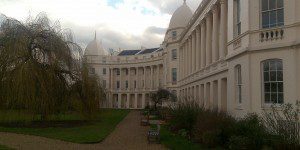
With a campus that abuts the beautiful, 395-acre Regent’s Park, central London’s largest open green space, LBS offers its students clean air and open space while remaining in the heart of bustling Central London. Buildings like the Sainsbury, one of LBS’s main structures, house all of the expected services in unexpectedly ornate and elegant architecture that gives LBS a timeless air.
Although the façades may suggest antiquity, LBS has stayed up-to-date technologically and continues to add to their campus facilities, notably signing a contract with Westminster City Council that will give the School the use of Old Marylebone Town Hall.
The school is easily accessible due to London’s extensive public transportation system. The city’s Heathrow, Gatwick, and City airports can all be reached within less than an hour via train. The UAE campus is located in the heart of Dubai.
Facilities
Facilities include the Sainsbury Building and the Plowden Building, which, between the two, contain 12 lecture halls, 100 seminar rooms, 10 function rooms, and six flat-floor teaching rooms.
In 2017, opened the brand new Sammy Ofer Centre, which will house three stories worth of advanced teaching facilities, six lecture theatres, a student lounge, 35 seminar rooms, a library, offices, staff and faculty suites, broadcast facilities and a new alumni centre. The building will be located in the Old Marylebone Town Hall.
Faculty
The London Business School faculty is made up of close to 150 members, and over 30 nationalities with an age range of 29 to 73. 26 percent of current faculty identify as female.
Student Body
Similarly diverse, the student body of London Business School consists of around 2,000 students per year.
MBA Degree Offerings
The London Business School offers a traditional full-time MBA, an Executive MBA (taught in London and Dubai), a Global Executive MBA through Columbia University in the U.S. and The University of Hong Kong, and several Masters programs.
Videos
My MBA Diary - Term OneA medical doctor, an investment manager and an events specialist give their initial thoughts on life at London Business School. Part one of this series follows three MBA2020 students, Faheem Ahmed, Zandile Nkwanyana and BriAnne Borup as they embark on their first MBA term at LBS. For more information on the MBA: https://www.london.edu/programmes/masters-courses/mba | Why we are who we areProfessor Nigel Nicholson joins Katie Pisa on The Why Podcast to explore why individuality matters more than ever in the age of AI, and why ignoring it carries serious consequences for leadership and relationships. Drawing on his latest book, ‘Unique You: How Individuality Works and Why It Matters’, Nigel explains why each person inhabits a distinct inner world shaped by biology and experience and why no two people ever truly share the same experience. The conversation examines how modern organisations often overlook individuality in favour of averages, categories and standardised metrics, and why this limits judgement, connection and performance at work. Three key themes emerge from the discussion: - Each individual lives within their own umwelt, meaning comparison and one-size-fits-all leadership approaches often miss what truly motivates people - Healthy relationships depend on recognition rather than sameness – learning to 'see and be seen' without comparing - As AI advances, uniquely human qualities such as intuition, meaning and moral judgement become both more valuable and more vulnerable For leaders and organisations, the episode offers a practical tool: decentring. This isn’t the same thing as empathy, Nigel explains. It’s the discipline of seeing the world from another person’s perspective. That's how to improve judgement, reduce conflict and build healthier workplaces. Discover more about Nigel and his research: https://www.london.edu/faculty-and-research/faculty-profiles/n/nicholson-n For more thought leadership and business insights from London Business School faculty and alumni, visit https://www.london.edu/think Sign up to receive a curated selection of articles, podcasts and films direct to your inbox twice a month at https://www.london.edu/think?entry=true#subscribeScreen Follow us on social media: https://x.com/LBS https://www.linkedin.com/school/london-business-school/ https://www.facebook.com/LondonBusinessSchool |

Schools and Programs You May Also Like
London Business School News
-
Apr 14, 2023
Clear Admit Virtual Event Series: MBA Application Overview -
Jun 20, 2022
Clear Admit MBA Essay Insight Webinar Series Summer 2022 -
Aug 5, 2021
MBA Essay Insight Event Series: Sept/Oct Dates! -
Mar 2, 2020
Where Should I Work: A.T. Kearney or Bain? -
Feb 21, 2020
Top MBA Recruiters: Goldman Sachs
All London Business School News »
